
Rules everything around me
weekly links #3

Các bạn,
These days it’s not a surprising statement to point out how biased human thinking is. There are a huge number of recognized cognitive biases (check out how long the Wikipedia page is), each with a special name and situation in which it occurs. Spotlight effect, hostile media bias, hindsight bias... the list seems to go on endlessly.
Is it all just confirmation bias?
Enter Toward Parsimony in Bias Research: A Proposed Common Framework of Belief-Consistent Information Processing for a Set of Biases, which argues that many biases may just be a couple beliefs & good old-fashioned confirmation bias in a trench coat.
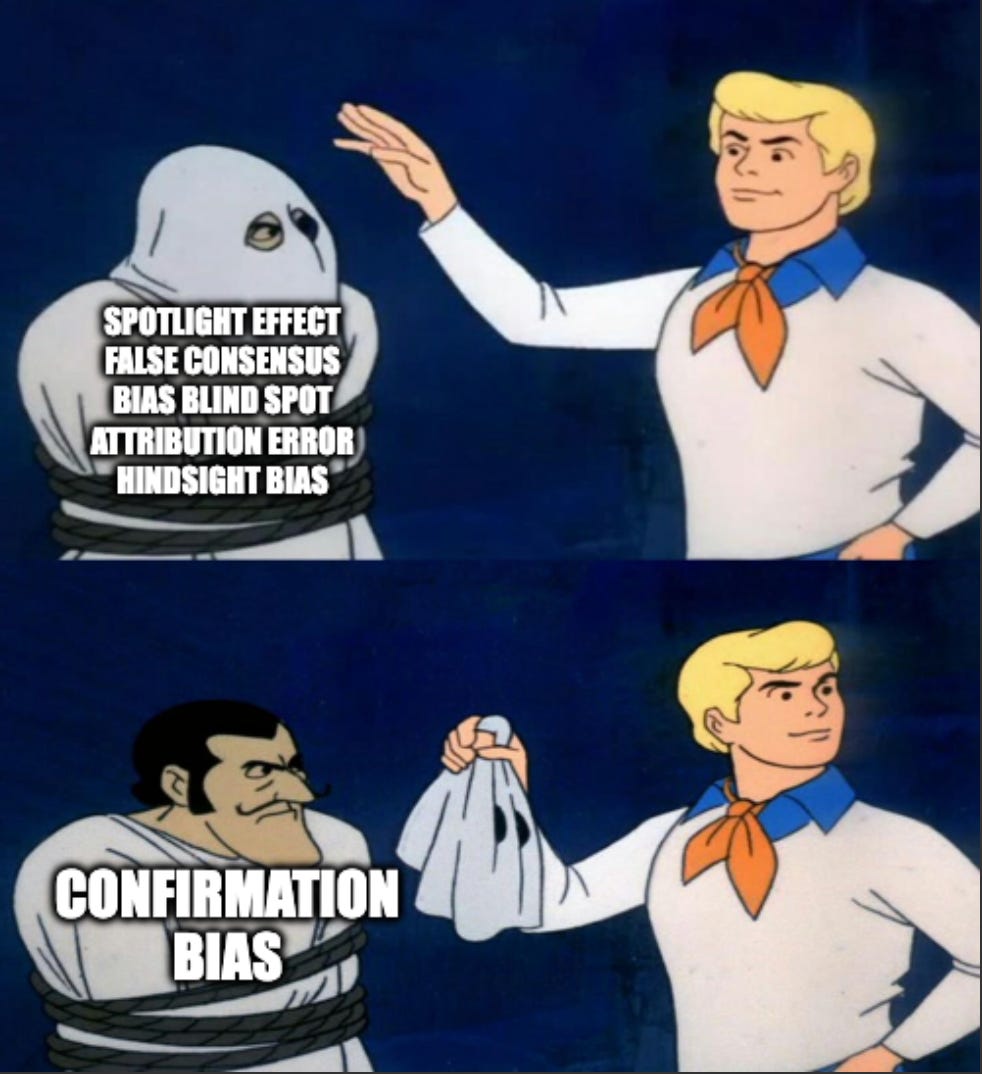
The idea is that many biases can be reformulated as a belief + processing information in a way that is consistent with that belief. Confirmation bias applied to some prior belief can give rise to many seemingly unrelated biases.
The authors term this belief consistent information processing, and point out how it can occur at all levels of cognition, including “attention, perception, evaluation of information, reconstruction of information, and the search for new information”.
For example, say you believe “My experience is a reasonable reference point.”
Then, at a party, you notice yourself feeling nervous when talking to someone. Because you notice so keenly that you’re nervous, and you believe your experience is a reasonable reference, you may interpret anything the other person says or does in a way consistent with this belief. Something innocuous they say might be interpreted as confirmation that they notice you’re nervous. This is known as the “spotlight effect.”
With this same belief of your experience being a reasonable reference for judgments about others, you can end up with “false consensus bias.” Here, you overestimate the extent to which other share your opinions. The process here could include things like:
You start with your opinion as the baseline, so you ask leading questions like “do others think this?” instead of “what do others think?”
You look for agreement (friends, social media, etc) more than disagreement
Counterexamples are discounted, eg treated as “exceptions”
You probably hang out with more like-minded people, so you have a biased sample
The information processing pipeline itself is skewed.
Notably, the above can occur even if you’re not motivated to be biased (eg you want to feel popular) and even if you don’t particularly care about the topic at hand. Confirmation bias is the granddaddy of all biases, and it seems to be applied unconsciously at all levels of information processing.
It’s probably fine to just be aware of this in most areas of your life. But for things you actually care about, it’s worthwhile to cultivate strategies to develop a more truthful view and counteract the confirmation bias. The primary tool I’m aware of to do this is writing – it forces you to make your thoughts rigid & you can explicitly “consider the opposite” of your view so you can learn.
Top links
Do the weirdest thing that feels right
I realized that when I think that something is ‘weird,’ it is not really about what I think at all.
Weirdness is a construct that is a stand-in for other people’s expectations.
I really like this criterion as a way to check with yourself that you’re not being guided by a fear of social death when trying to make a decision between equally reasonable options. May we all do weirder things.
Mentabolism
“Your ability to generate power is directly proportional to your ability to relax.” (David Allen)
In terms of macronutrients for information:
CHO - News, emails, reels, summaries, tweets, pop science, memes.
FAT - Real life, books, history, world models, myths, deep science.
PRO - Sleep, idle musings, conversation, breaks, walks, touching grass, naps.
A slightly different take on knowledge work, discussing how you might produce good work over the longer term without burning out. The essence is doing a lot of work over a long period of time, but mostly at a relaxed pace. Obviously there are other inputs, but I have getting behind this idea of relaxation as a key overlooked ingredient for creativity more and more lately.
The handoff to bots
A lot to say about this, which I will save for a future post, but for now I’ll just recommend reading the original post and note the many clear connections to Isaac Asimov’s Robot trilogy. No spoilers, but suffice to say the Asimov series explores the impact on a society of low fertility, extreme longevity, and an over-reliance on robots. Wonder if we’re hurtling towards becoming one of Asimov’s Spacer worlds right now.
IRL (In Rami’s Life)
Last week, Rami was spotted at the Reston Zoo and at Meadowlark Botanical Gardens. Witnesses are surprised at how many activities an almost 5 months baby can get up to in just a week. The goats at the zoo report that Rami was a little afraid of them (goats do look scary tbf – there’s a reason they’re associated with the devil), but the red bushy tailed lemurs report he was fascinated by them. The lemurs were surprised they lost a staring contest to Rami. At the drive-through safari park portion of the zoo, Rami wasn’t able to see too much but he did catch glimpses of the llamas that accosted the car hoping to get some food. Unfortunately Rami’s parents hadn’t purchased the expensive animal feed, so the llamas blocked the car’s path for a few minutes. Their focus on obtaining food is second only to Rami, who full body lunges to try to get whatever his parents are eating.
Yesterday, Rami also attended his second wedding. Dressed in a dapper green suit with matching bowtie, Rami wowed the guests with his stylish attire. He got some cute pics with the bride and groom but quickly succumbed to the fact that it was well past his bedtime and fell fast asleep while being held by Vani aunty, a family friend. His parents put on his noise canceling headphones and he ended up sleeping deeply on her through the rest of the event, only waking up near the end in a confused daze. Sources are still shocked at his ability to sleep through an Indian wedding event.
Let’s chat!
Wanna chat about literally anything?
Excellent analysis! That 'belief-consistent information procesing' idea is such an elegant way to frame things. It really makes you wonder how many of our deeply held 'priors' are just stubborn defaults. It's so hard to debug those mental algorithms sometimes, even when we try. Makes me think of bias in AI training, too!